Called me old fashioned
‘How do you sell?’
Or, my preferred question would be, ‘how do you buy?’.
I imagine you’re a discerning buyer and you’re not alone. As consumers, we buy things because they are delicious, beautiful, beneficial, or just plain old bargains. What we value varies across different products and services, but we see a measure of value in everything we buy.
Bringing things to market that deliver value to an audience isn’t just a strategic concept, it’s the core principle of a successful sales strategy.
Some consider this perspective rather simplistic and old-fashioned for today’s world, however, I don’t just think it; I’ve done it. And, after achieving consistent success with this approach across different businesses and operating models, I’ve codified it.
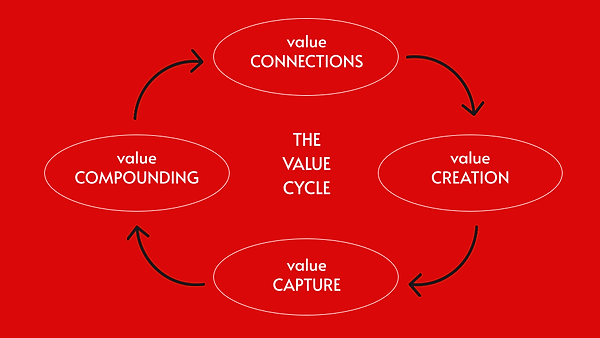
My approach involves centring ‘value’ at the core of every business activity and conversation. I put this into action through a continuous and incremental cycle, segmented into 4 distinct stages. Here it is:
Below is how I define the 4 stages:
In our increasingly complex, complicated and convoluted world, many businesses are actively engaged in devising ever more elaborate and aggressive sales strategies. But recently successful market disruptors such as Ninja (air fryer), Open AI (ChatGPT), and Perplexity (AI search) didn’t arrive in the marketplace with bombastic acquisition strategies or sales gimmicks. Very simply, they arrived delivering tangible value to an audience.
This is achieved by seeing sales as an aggregation and culmination of your value-cycle activities, not as an action plan slapped on the end of a business strategy. Absolutely, there is a need to set targets; they are essential to determine, prioritise, steer and cultivate business activities and innovation to realise expectations. This is precisely why sales is an operating model rather than merely an activation activity; and why a value-cycle is how you do it, not why you do it.
Let’s bring my value cycle to life with an analogy, the Old Fashioned cocktail, and apply it both conceptually and practically:
Conceptually: you take the base ingredients (departmental/functional innovation) and blend them together to create something even more impressive and impactful. Sure, you can take a shot (!) but selectively blending ingredients to create a drink elevates the magic significantly.
Practically: here’s how my cycle can be applied to the launch of……a cocktail:
-
CONNECTIONS: observe, analyse and identify what drinks customers are enjoying, and determine the dimensions that are making a drink more successful to create a set of building blocks (spirit+sugar+water+bitters)
-
CREATION: use those building blocks to craft a new blend, and determine a method for quality and consistency. Package in a signature piece of glassware with a signature garnish
-
CAPTURE: put your creation at the top of your menu in pride of place, and give it an enticing description with a reassuringly premium price point for exclusivity. Oh, and dim the lights for full effect
-
COMPOUNDING: Offer seasonal variations, do spirit collaborations and incrementally extend your menu with more delicious creations, broadening the offering, and insights, for different palettes.
To conclude, let’s take this analogy out of the business context and back to where we started by taking a glance from the buyer’s perspective. Although the origin of the Old Fashioned recipe is unknown and disputed, its name ‘Old Fashioned’ tells a very interesting customer story.
During the 1870s, the whisky cocktail (as it was known up to that point) was widely available. During this period there was a flurry of drink innovation and many new spirits were entering the market leading to the situation where the whisky cocktail was completely different every time a customer ordered it. This led to frustration from customers who started to request the cocktail the ‘old fashioned’ way, hereby crystallising their expectations and the signature drink was truly born.
This story serves to remind us that customers are the arbiters of value and that they don’t enjoy poorly conceived products and services or gimmicks for long. Rather, they seek thoughtful solutions to their needs, and for that, they will reward you handsomely.
‘Cheers!’ to that!
Autumn 2024